Why PPE Alone Does Not Make a Workplace Safe
PPE is important, but it is not enough on its own. Learn why safer workplaces need hazard identification, hierarchy of controls, training, supervision, safe procedures, inspections, and strong safety systems.
On This Page
- 01. Why PPE matters
- 02. Why PPE alone is not enough
- 03. The hierarchy of controls
- 04. PPE as the last line of defense
- 05. Common examples of PPE misuse
- 06. Why the right PPE must match the hazard
- 07. PPE and the false sense of safety
- 08. What a safer workplace needs beyond PPE
- 09. The role of training and supervision
- 10. How safety inspections support PPE compliance
- 11. How safety systems improve PPE management
- 12. Practical PPE checklist for workplaces
- 13. Key takeaway
- 14. References and further reading
PPE is important.
Helmets, gloves, goggles, masks, safety boots, ear protection, face shields, and reflective vests all play a role in protecting workers from injuries and harmful exposures.
But PPE alone does not make a workplace safe.
A workplace can have workers wearing PPE and still remain unsafe if hazards are poorly controlled, procedures are weak, supervision is inconsistent, training is missing, or risks are allowed to remain in the work environment.
PPE should protect workers from remaining risks.
It should not be used as a replacement for proper safety management.
A safer workplace is built when hazards are identified, assessed, controlled, monitored, and followed up consistently.
01. Why PPE Matters
Personal Protective Equipment is one of the most visible parts of workplace safety.
When people see workers wearing helmets, gloves, safety boots, reflective vests, masks, or goggles, they quickly associate that environment with safety awareness.
PPE helps create a barrier between the worker and the hazard.
It can reduce the impact of risks such as falling objects, sharp materials, chemical splashes, dust, fumes, noise exposure, heat, flying particles, slippery surfaces, biological hazards, and electrical hazards.
OSHA explains that when engineering, work practice, and administrative controls are not feasible or do not provide enough protection, employers must provide PPE and ensure proper use.
This means PPE is necessary when risks remain after other control measures have been considered.
However, the important point is this:
PPE is not the whole safety system.
It is only one part of the safety system.
A helmet can reduce the impact of a falling object, but it does not stop the object from falling. Gloves can protect hands, but they do not make a dangerous machine safe. Safety boots can protect feet, but they do not remove poor housekeeping hazards.
PPE matters because workers need protection.
But a workplace should also ask whether the hazard can be removed, reduced, isolated, controlled, or managed better before depending mainly on protective equipment.
Deciding how much a workplace should depend on PPE versus other controls is part of the broader Occupational Safety & Health support.
02. Why PPE Alone Is Not Enough
PPE mainly protects the worker from the hazard.
It does not usually remove the hazard itself.
For example:
- A helmet does not stop materials from falling.
- Gloves do not make unsafe machine operation safe.
- Safety boots do not remove clutter from walkways.
- A reflective vest does not control moving vehicles.
- Goggles do not correct poor chemical handling.
- Ear protection does not reduce noise at the source.
- A dust mask does not remove harmful dust from the work process.
This is why relying only on PPE can create a false sense of safety.
Workers may feel protected because they are wearing safety gear, while the real risk remains uncontrolled.
A safer workplace should not only ask:
“Are workers wearing PPE?”
It should also ask:
“Have we controlled the hazard properly?”
For example, if workers are exposed to dust, providing masks may be necessary. But the workplace should also consider whether dust can be reduced through better ventilation, wet methods, enclosure, extraction systems, or changes in the work process.
If workers are exposed to falling objects, helmets are important. But the workplace should also look at material storage, lifting methods, exclusion zones, overhead work control, and supervision.
PPE reduces exposure.
Safety systems reduce risk.
Both are important, but they are not the same.
03. The Hierarchy of Controls
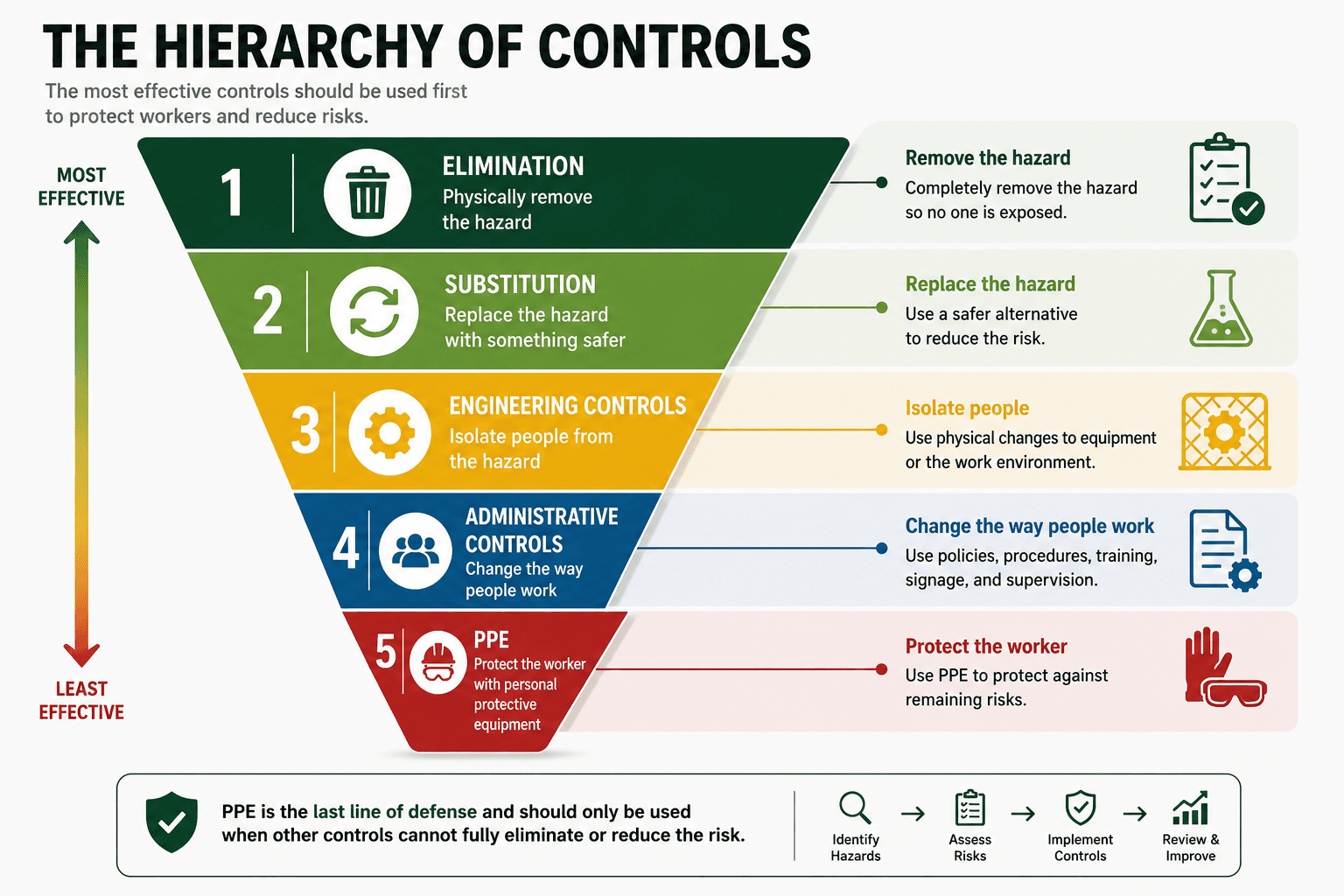
The hierarchy of controls is one of the most important concepts in workplace safety.
It helps workplaces choose the most effective ways to control hazards.
The common order is:
- Elimination — remove the hazard completely.
- Substitution — replace the hazard with something safer.
- Engineering controls — isolate people from the hazard.
- Administrative controls — change how people work through procedures, training, permits, supervision, signage, and schedules.
- PPE — protect the worker from remaining exposure.
NIOSH describes the hierarchy of controls as the preferred order of actions for controlling hazardous workplace exposures, and it states that employers should not rely on PPE alone when other effective control options are available.
This is why PPE is often described as the last line of defense.
It is still important, but it is less effective than removing or reducing the hazard at the source.
OSHA's hazard prevention guidance also presents PPE as less effective compared with elimination, substitution, engineering controls, and administrative controls.
A workplace that understands the hierarchy of controls does not rush to PPE first.
It first asks whether the hazard can be eliminated, replaced, engineered out, or controlled through safe systems of work.
Working through that order systematically is exactly what risk assessment support.
04. PPE as the Last Line of Defense
PPE is called the last line of defense because it protects the worker when other controls are not enough.
This does not mean PPE is unimportant.
It means PPE should not be the only protection workers depend on.
For example, in a noisy workplace, ear protection can help reduce exposure. But the workplace should also consider whether the noise can be reduced through quieter equipment, maintenance, isolation, barriers, or scheduling.
In a chemical handling area, gloves and goggles may be required. But the workplace should also review chemical storage, labelling, ventilation, spill control, safety data sheets, and emergency response.
In a construction or maintenance environment, helmets and safety boots may be necessary. But the workplace should also look at lifting practices, falling object prevention, housekeeping, access control, and safe work procedures.
PPE becomes more effective when it is supported by stronger controls.
When PPE is used without proper hazard control, the worker remains too close to the danger.
That is why workplaces should avoid using PPE as a shortcut.
05. Common Examples of PPE Misuse
PPE can fail to protect workers when it is selected, used, or maintained poorly. Some common examples include:
- Using the wrong gloves — fabric gloves may not protect against chemicals, thin disposable gloves may not protect against sharp objects, and heat-resistant gloves may not suit chemical handling. The wrong glove can increase risk because the worker may assume they are protected when they are not.
- Wearing damaged PPE — cracked helmets, torn gloves, scratched goggles, worn-out boots, or damaged masks may not provide proper protection and should be inspected before use and replaced when damaged.
- Using PPE without training — workers need to know why PPE is required, how to wear it correctly, when to replace it, how to store it, and what limitations it has, otherwise it may be worn incorrectly or ignored.
- Wearing PPE only during inspections — some workers wear PPE only when supervisors, auditors, or visitors are present, showing PPE has not become part of the workplace safety culture.
- Treating PPE as the full safety solution — PPE should not be used to hide poor housekeeping, weak procedures, unsafe equipment, lack of supervision, or missing risk controls.
- Sharing PPE without hygiene control — respirators, gloves, ear protection, and face shields may require specific cleaning, storage, and replacement procedures when shared.
- Poor fit and discomfort — PPE that does not fit properly may not protect workers effectively; if it is uncomfortable, too loose, too tight, too hot, or unsuitable, workers may remove it or use it incorrectly. This is why worker feedback matters when selecting PPE.
06. Why the Right PPE Must Match the Hazard
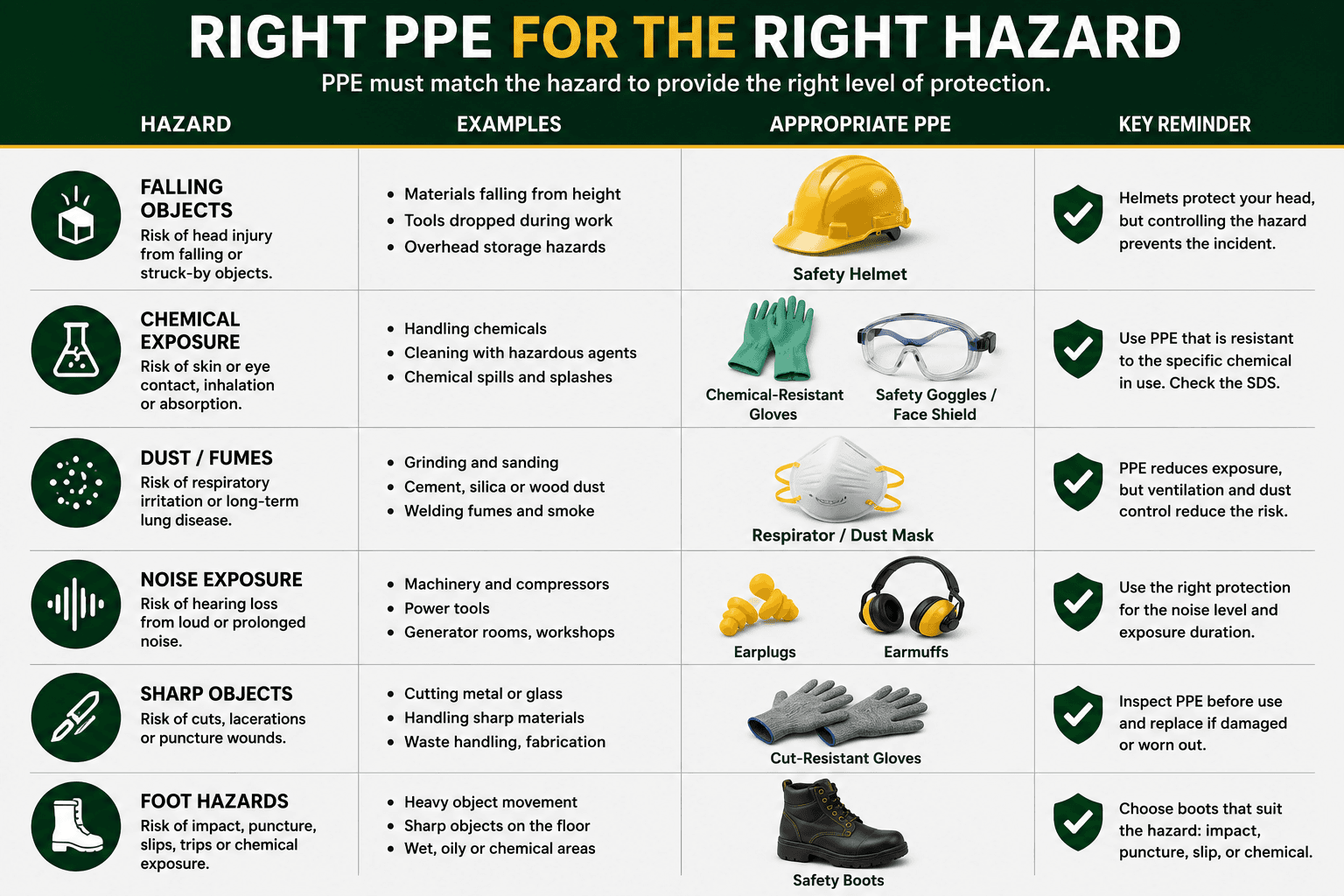
PPE should never be selected randomly.
The correct PPE depends on the task, the hazard, and the level of exposure.
OSHA's PPE assessment guidance notes that the nature of the hazards and the operation being performed determine PPE selection, including glove selection.
This is especially important for hand protection, respiratory protection, chemical handling, eye protection, hearing protection, and electrical work. For example:
- Cut-resistant gloves are used for sharp materials.
- Chemical-resistant gloves must match the chemical being handled.
- Electrical insulating gloves are used for electrical tasks.
- Heat-resistant gloves are used for welding or hot surfaces.
- Safety goggles protect against particles or splashes.
- Respirators must match the respiratory hazard.
- Ear protection must match the noise exposure level.
- Safety boots should match the risk of impact, puncture, slipping, or chemical exposure.
A PPE program should include hazard assessment, selection, care, use, training, and monitoring. OSHA's PPE overview highlights proper PPE selection and usage as part of protecting workers.
The right PPE can protect the worker.
The wrong PPE can expose the worker to harm.
A workplace should therefore avoid selecting PPE based only on availability, price, or appearance.
PPE must be suitable for the hazard.
07. PPE and the False Sense of Safety
One of the biggest risks of depending too much on PPE is that it can create a false sense of safety.
A worker may feel protected because they are wearing PPE, while the actual hazard remains uncontrolled.
For example, a worker wearing gloves may continue handling sharp materials carelessly. A worker wearing safety boots may walk through a cluttered area without recognizing the trip hazard. A worker wearing a reflective vest may assume they are visible enough, even when traffic control is poor.
This is dangerous because PPE can sometimes make people less alert to the source of risk.
Safety should not encourage the idea that wearing PPE means the job is automatically safe.
A better safety culture teaches workers to ask:
- What can harm me?
- Has the hazard been controlled?
- Is the procedure safe?
- Is the equipment in good condition?
- Is the PPE suitable?
- Do I understand the task?
- Do I need to stop and report a hazard?
This way, PPE becomes part of safety awareness rather than a replacement for it.
08. What a Safer Workplace Needs Beyond PPE
A safer workplace needs more than protective equipment. It needs a complete safety approach. This includes:
- Hazard identification
- Risk assessment
- Safe work procedures
- Worker training
- Good housekeeping
- Regular inspections
- Equipment maintenance
- Clear supervision
- Emergency preparedness
- Incident reporting
- Near-miss reporting
- Corrective action follow-up
- Proper documentation
For example, if workers are exposed to falling objects, helmets are important. But the workplace should also review:
- How materials are stored
- Whether overhead work is controlled
- Whether exclusion zones are marked
- Whether lifting procedures are safe
- Whether workers are trained
- Whether supervisors are monitoring the task
If workers are exposed to chemicals, gloves and goggles may be necessary. But the workplace should also review:
- Chemical substitution
- Ventilation
- Labelling
- Safety data sheets
- Storage practices
- Spill response
- Worker training
- Emergency eyewash facilities
This is the difference between protecting workers from risk and controlling risk properly.
PPE protects the worker.
Systems help control the hazard.
09. The Role of Training and Supervision
PPE compliance depends heavily on training and supervision.
Workers need to understand not only what PPE to wear, but also why it is required. Training should explain:
- The hazards present
- The type of PPE required
- How to wear PPE correctly
- When PPE should be used
- PPE limitations
- How to inspect PPE before use
- How to clean and store PPE
- When PPE should be replaced
- What to do when PPE is missing or damaged
Supervision then helps turn training into practice.
Without supervision, PPE use may become inconsistent.
Workers may remove PPE when uncomfortable, use the wrong item, ignore procedures, or use PPE only when someone is watching.
Supervisors help reinforce expectations, correct unsafe behavior, and identify repeated gaps.
Good supervision is not about policing workers harshly.
It is about ensuring that safe practices become normal.
10. How Safety Inspections Support PPE Compliance
Safety inspections help identify whether PPE is being used properly. An inspection can reveal:
- Missing PPE
- Wrong PPE for the task
- Damaged PPE
- Poor storage
- Lack of PPE signage
- Workers wearing PPE incorrectly
- PPE not being replaced on time
- PPE availability problems
- Repeated non-compliance in certain departments
But inspections should not only identify the problem.
They should lead to corrective action.
For example, if workers are not wearing gloves, the solution may not be simply to tell them to wear gloves.
The inspection should ask why.
Maybe the gloves are not available. Maybe they are uncomfortable. Maybe they are not suitable for the task. Maybe workers were not trained. Maybe supervision is weak. Maybe the task itself needs a better control method.
This is why inspection findings should be connected to follow-up.
A workplace should not only record PPE gaps.
It should understand and correct the cause behind them.
11. How Safety Systems Improve PPE Management
PPE compliance improves when it is supported by systems.
A workplace should not depend only on reminders or verbal instructions.
A good PPE management system can help track:
- PPE requirements by task
- PPE issue records
- Inspection schedules
- Replacement dates
- Worker training
- PPE defects
- Non-compliance observations
- Corrective actions
- PPE suppliers
- Stock availability
- Department PPE needs
Digital systems can make this easier.
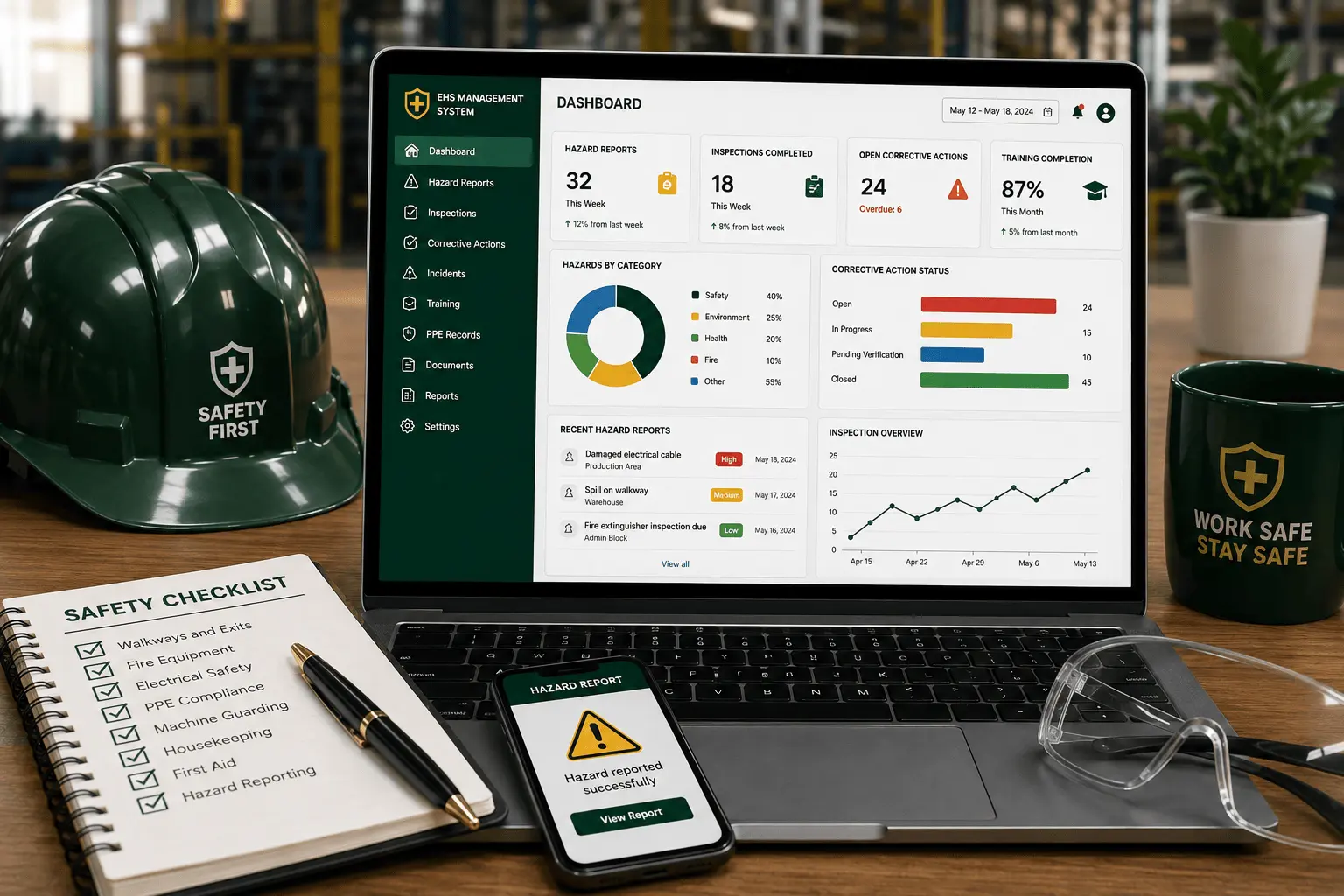
For example, a simple PPE tracker can show who received PPE, when it was issued, when it should be replaced, and whether workers have been trained on correct use.
Inspection checklists can also include PPE compliance observations.
Corrective action systems can help track repeated PPE gaps and identify whether the issue is lack of training, poor supervision, wrong PPE selection, discomfort, or poor availability.
This connects well with the kind of digital reporting systems work like the Digital Inspection & Audit System.
Safety becomes easier to manage when records are clear, responsibilities are assigned, and follow-up is consistent.
12. Practical PPE Checklist for Workplaces
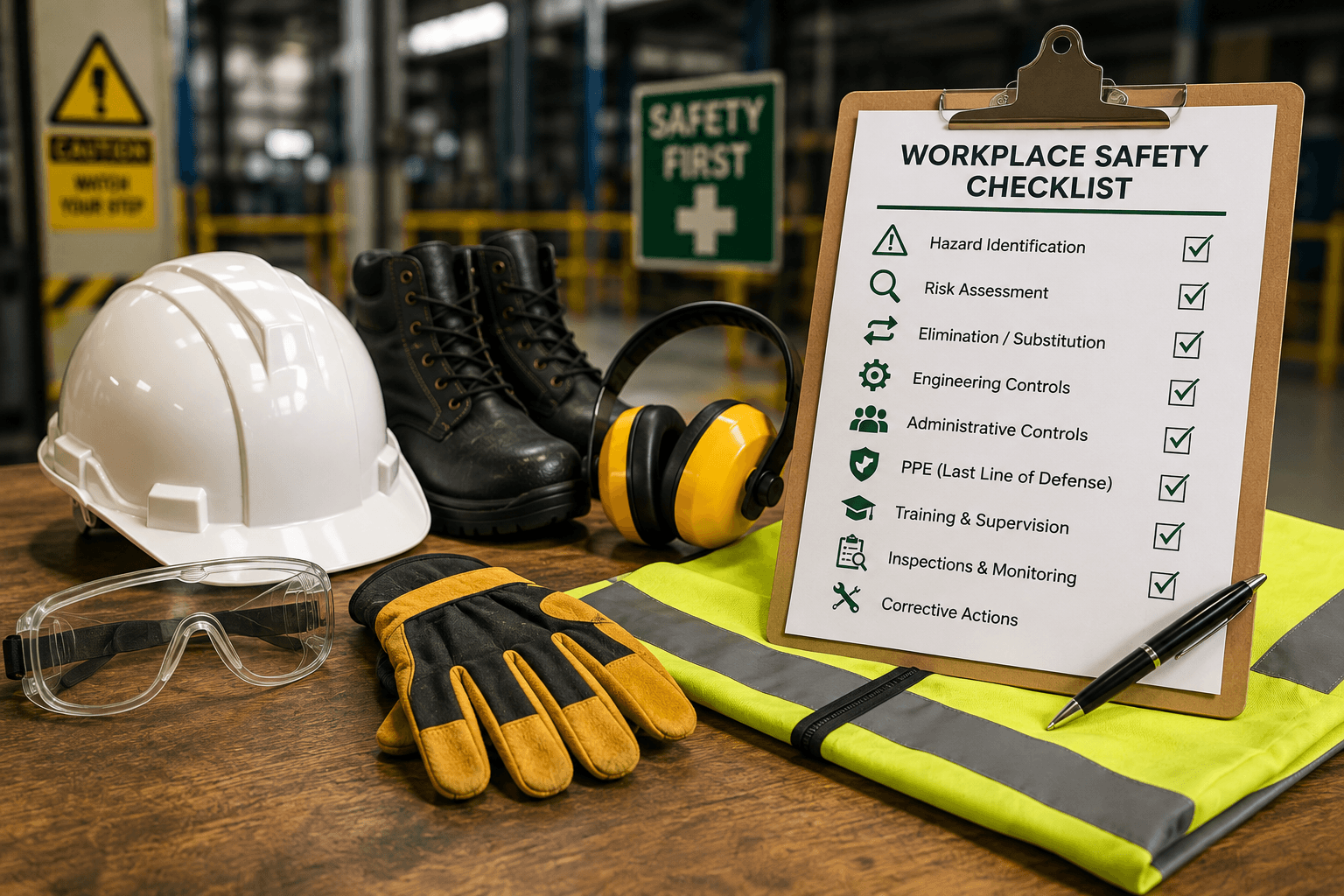
A simple PPE checklist can help workplaces improve safety practice. Before using PPE, ask:
- Has the hazard been identified?
- Can the hazard be eliminated?
- Can it be substituted with a safer option?
- Can engineering controls reduce exposure?
- Are safe procedures in place?
- Has the correct PPE been selected?
- Does the PPE match the hazard?
- Does the PPE fit the worker properly?
- Has the worker been trained?
- Is the PPE clean and undamaged?
- Is replacement PPE available?
- Is PPE use being supervised?
- Are PPE records being maintained?
- Are workers reporting PPE defects?
- Are repeated PPE gaps being reviewed?
- Is PPE being used alongside other controls?
This checklist helps shift the focus from simply wearing PPE to managing risk properly.
It also reminds workplaces that PPE must be part of a wider safety system.
13. Key Takeaway
PPE is important, but it is not enough on its own.
A safer workplace is built when hazards are identified, controlled, monitored, and followed up.
PPE should protect workers from remaining risks, but it should not replace proper safety procedures, training, supervision, inspection, and hazard control.
The best approach is to control hazards at the source first, then use PPE as part of the overall protection system.
Workplace safety should not only ask:
“Are workers wearing PPE?”
It should also ask:
“Have we reduced the risk properly?”
PPE protects workers. Systems make workplaces safer.
If your organisation needs help reviewing hazard controls and PPE practices, get in touch through my contact page.