When people hear about occupational safety and health, they often think about PPE, inspections, audits, fire extinguishers, risk assessments, and compliance. When they hear about digital solutions, they think about websites, systems, automation, online visibility, and technology.
At first, these two areas may look different. However, the more I learned and worked in both spaces, the more I realized that occupational safety and health with digital solutions are deeply connected.
Both are about creating better systems.
Occupational safety protects people, workplaces, and business operations. Digital solutions help businesses organize work, communicate better, track information, and improve efficiency. When combined, they can help organizations become safer, smarter, and more accountable.
That is why I chose to bring these two areas together in my professional journey.
My Interest in Occupational Safety and Health
My interest in occupational safety and health comes from understanding how important safe workplaces are. Every worker deserves to go home safe at the end of the day. Every business also has a responsibility to manage risks, protect people, and create a work environment where safety is taken seriously.
Occupational safety is not only about meeting legal requirements. It is about preventing harm before it happens.
A good safety system helps a workplace identify hazards, assess risks, train workers, respond to emergencies, and follow up on corrective actions. It also helps management make better decisions because safety information is clear and organized.
However, I have also noticed that many safety challenges are not caused by lack of effort. Sometimes, the real problem is poor organization.
For example, a workplace may conduct inspections but fail to follow up on findings. Another company may have safety records, but they are scattered in different files. A business may conduct training, but the records are not easy to trace. In some cases, hazards are reported verbally and later forgotten.
This is where digital solutions become useful.
Why Digital Solutions Became Part of My Journey
Digital solutions became important to me because I saw how much they can improve communication, organization, and visibility.
A simple digital system helps a business keep records, track tasks, manage client communication, and organize information. Through a website, a business can explain its services clearly. SEO helps people find that business online, while digital forms make reporting easier. Automation also reduces repeated manual tasks.
As I continued learning, I realized that digital solutions are not only for technology companies. They add value in almost every field, including occupational safety and health.
Safety work involves a lot of information. Teams handle inspection reports, audit findings, risk assessments, training records, incident reports, corrective actions, emergency contacts, certificates, permits, and compliance reminders. If businesses do not manage this information well, they struggle to track safety. Digital tools make that process easier.
How Occupational Safety and Digital Solutions Connect
Occupational safety and digital solutions connect through systems, communication, and follow-up.
Safe workplaces need more than safety documents. They require clear processes that people follow consistently. In the same way, a good digital solution is not just about having software or a website. It solves a real problem through structure and innovation.
For example, when a workplace identifies a hazard, the next questions should be: who will correct it, when will they correct it, and how will the team confirm that action has been taken?
Without a proper system, people may forget that finding. A simple digital solution allows teams to record, assign, track, and review the issue. That process creates accountability.
This is the connection I saw. Digital solutions can support occupational safety by making safety activities easier to manage through modern digital systems.
Practical Ways Digital Solutions Can Support Occupational Safety
There are many practical ways digital solutions can improve occupational safety and health.
1. Safety Inspection Records
Instead of writing inspection findings in notebooks that may be misplaced, workplaces can use digital forms or spreadsheets to record observations.
That approach makes it easier to review findings, identify repeated issues, and follow up on corrective actions.
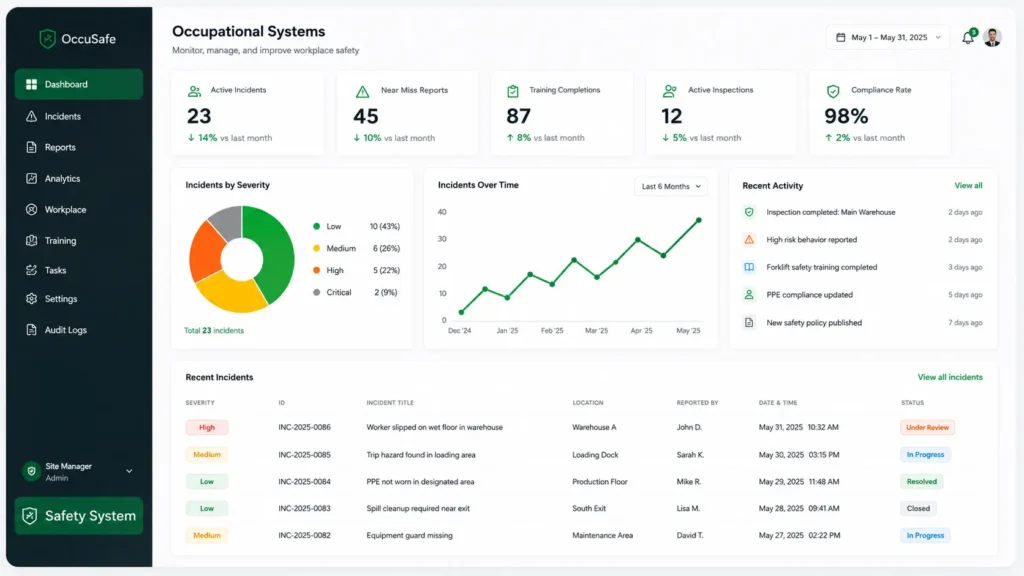
A safety and health management system dashboard.
2. Corrective Action Tracking
Safety audits only creates value when the team implements the recommendations.
Digital tools help managers track each action, assign responsibility, set deadlines, and monitor completion status. As a result, businesses move from reporting problems to solving them.
3. Incident and Near-Miss Reporting
Many workplaces fail to capture near misses because workers find reporting difficult or unclear.
A simple digital reporting form encourages faster reporting and quicker response. When teams record incidents and near misses properly, the business can learn from them and prevent future accidents.
4. Training Records
Training plays an important role in occupational safety, but scattered records can make follow-up difficult.
Digital records help managers track who completed training, when the session took place, and when refresher training is due.
5. Compliance Reminders
Some safety tasks repeat regularly. These include fire safety audits, equipment inspections, first aid training, emergency drills, risk assessments, and statutory renewals.
Digital reminders help businesses avoid missing important safety activities.
6. Safety Communication
Digital solutions also improve safety communication. Businesses can use safety posters, newsletters, WhatsApp updates, website notices, digital induction materials, and simple awareness content.
Clear communication helps workers understand risks and take safety seriously.
7. Better Report Presentation
A clear safety report helps managers understand the findings and act on them quickly.
Digital tools help teams organize findings, images, recommendations, and action plans in a professional way. Better presentation improves decision-making and makes safety information more useful to management.
Why This Combination Matters for Businesses
Many businesses want to improve safety, but they also need practical systems that are easy to use.
Combining occupational safety and health with digital solutions helps businesses move from manual, scattered, and reactive safety practices to more organized and proactive systems.
This matters because poor systems can lead to repeated hazards, missed deadlines, weak follow-up, and poor communication.
For example, if an audit identifies blocked emergency exits but no one tracks the corrective action, the same issue may appear again in the next inspection. If training records are not organized, it becomes difficult to know who needs refresher training. If incidents are not recorded properly, the business may miss important warning signs.
Digital solutions do not replace safety professionals. Instead, they support better safety management.
This combination also matters for professionals like me. Today, professionals need more than one skill. The workplace is changing, and many fields are becoming more digital.
Occupational safety is also changing because organizations now need better data, better reporting, better communication, and better follow-up systems.
By combining occupational safety and health with digital solutions, I am building a professional path that is practical and future-focused.
How This Combination Helps Me Serve Businesses Better
This combination allows me to support businesses in different ways, including:
- Improving safety communication
- Organizing safety records
- Creating better reporting systems
- Supporting online visibility
- Designing digital tools and systems
- Helping businesses communicate their services clearly
- Building safer and smarter workflows
This makes my work more useful because it connects safety, technology, communication, and business improvement.
Common Problems This Approach Can Help Solve
Many businesses face similar challenges. These challenges may look small at first, but they can affect safety, productivity, and professionalism.
Scattered Records
Safety documents may be stored in different folders, emails, notebooks, or devices. This makes it hard to retrieve information when needed.
Poor Follow-Up
Teams may note audit findings and inspection recommendations but fail to act on them.
Weak Communication
Workers may not receive clear safety messages. Customers may also struggle to understand what a business offers. Digital communication can improve both.
Repeated Mistakes
When incidents, hazards, and corrective actions are not tracked, the same problems can happen again.
Low Online Visibility
Some businesses do good work but are not visible online. A website, SEO, and consistent content can help build trust and attract clients.
Manual Workload
Some tasks are repeated manually when simple digital tools could save time and reduce errors.
My Vision for Combining Safety and Digital Work
My vision is to help businesses and professionals build systems that are not only attractive, but useful.
A beautiful website is good, but one that helps customers understand your services is better.
Safety reports are important, but they become more valuable when they lead to action.
Digital tools are useful, but the best tools solve real business problems.
That is the kind of work I want to focus on.
I want to create and support solutions that help businesses become:
- Safer
- More organized
- More visible
- More professional
- More efficient
- More trusted
This is why I do not see occupational safety and digital solutions as separate paths. I see them as two sides of the same goal: helping people and businesses work better.
Lessons I Have Learned So Far
This journey has taught me several important lessons.
Systems Make Work Easier
When information is organized, decisions become easier. Whether it is a safety file, website content, customer record, or audit report, structure matters.
Discipline Builds Better Results
Good systems require consistency. Whether in safety or digital work, discipline helps ensure that tasks are completed, records are updated, and improvements are followed through.
Safety Needs Follow-Up
Identifying a hazard is only the first step. The real value comes when action is taken and tracked.
Digital Tools Should Be Simple
A digital solution does not have to be complicated. Sometimes a simple form, spreadsheet, dashboard, or website section can solve a serious problem.
Communication Builds Trust
People trust what they understand. Clear safety communication and clear business communication both help build confidence.
Continuous Learning Is Important
Both safety and digital work continue to change. Therefore, learning must be part of the journey.
Final Thoughts
I combined occupational safety and digital solutions because both areas are about improving how work is done.
Occupational safety helps protect people. Digital solutions help organize systems, improve communication, and support better decisions. When these two areas work together, businesses can become safer, smarter, and more prepared for growth.
This journey reflects who I am as a professional.I care about safety, but I also care about systems.
Digital tools matter to me, but people remain at the center of the work.
Good systems should make work safer, easier, and more effective.
That is why this combination matters to me.
Need Support with Safety and Digital Systems?
If you need help with workplace safety communication, digital systems, web development, SEO, or better business processes, I would be happy to connect.
Let’s build safer, smarter, and more organized systems together.